- Beam Clarity
- Posts
- Mind matters
Mind matters
A closer look at adolescent mental health
It is hard to believe that it has been six months since we started Beam. Six months in the life of a small consulting business is both a long and a short time. Like parents are often told: the days are long, but the years are short. Short in the brand building sense. Long in the experimental, systems building and conversation sense. We’ve tried many things!
Since we started Beam, we’ve experimented with different types of projects in the behavioural design and communication space. We are sharing just some of our projects here:
 | Science communication strategy: A strategy, drawing on behavioural science, on how to communicate the findings of a complex, causal study on the impact of early childhood development attendance on primary school education outcomes. Read the original research paper here. |
 | Behavioural intervention design: Support, in the role of knowledge translator, in the design of a behavioural intervention on water safety in a township close to Grabouw. The intervention, in the form of a wonderful film in collaboration with Reel Epic Productions, will be rolled out from the end of September after which we will be able to share more on this project. |
 | Research and communication on complex data topics: We are currently deeply immersed in the topic of food security, and more specifically, dietary diversity, in South Africa as we work on updating the Food Security Index for Shoprite. See last year’s Food Security Index here. |
 | Information design training: Training for a development consultancy on “how to visualise” in their work, going beyond quantitative data visualisation and bringing visual elements to their broader insight and information communication. More on our training offerings later. |
Another space for experimentation has been our fortnightly newsletter. When we started Beam, we wanted to show our range: tackling science communication on everything from stokvels and savings, to ocean health, early childhood development and reading, and even the life-changing impact of the HPV vaccine. We’ve also tested broader framings to see how our audience reacts.
After nine newsletters in which we’ve shown our visualisation and accessible writing capabilities, it is time to return to the topics we think we know best: research and analysis and behavioural design in the context of the health, financial and education sectors. Aligning with this shift, we will also be sharing information monthly through our newsletters from inside the Beam world.
Spotlight
In this week’s newsletter, we write about adolescent mental health.
Former American Surgeon General, Vivek Murthy, referred to mental health as “the defining public health crisis of our time” in an X post in 2023. Since then, multiple authors have attributed his quote to child mental health, extending it to apply to adolescent mental health.
This topic has captured the minds and worries of health economists, psychologists, journalists, social commentators (just see Facebook comments!), teachers and, importantly, parents.
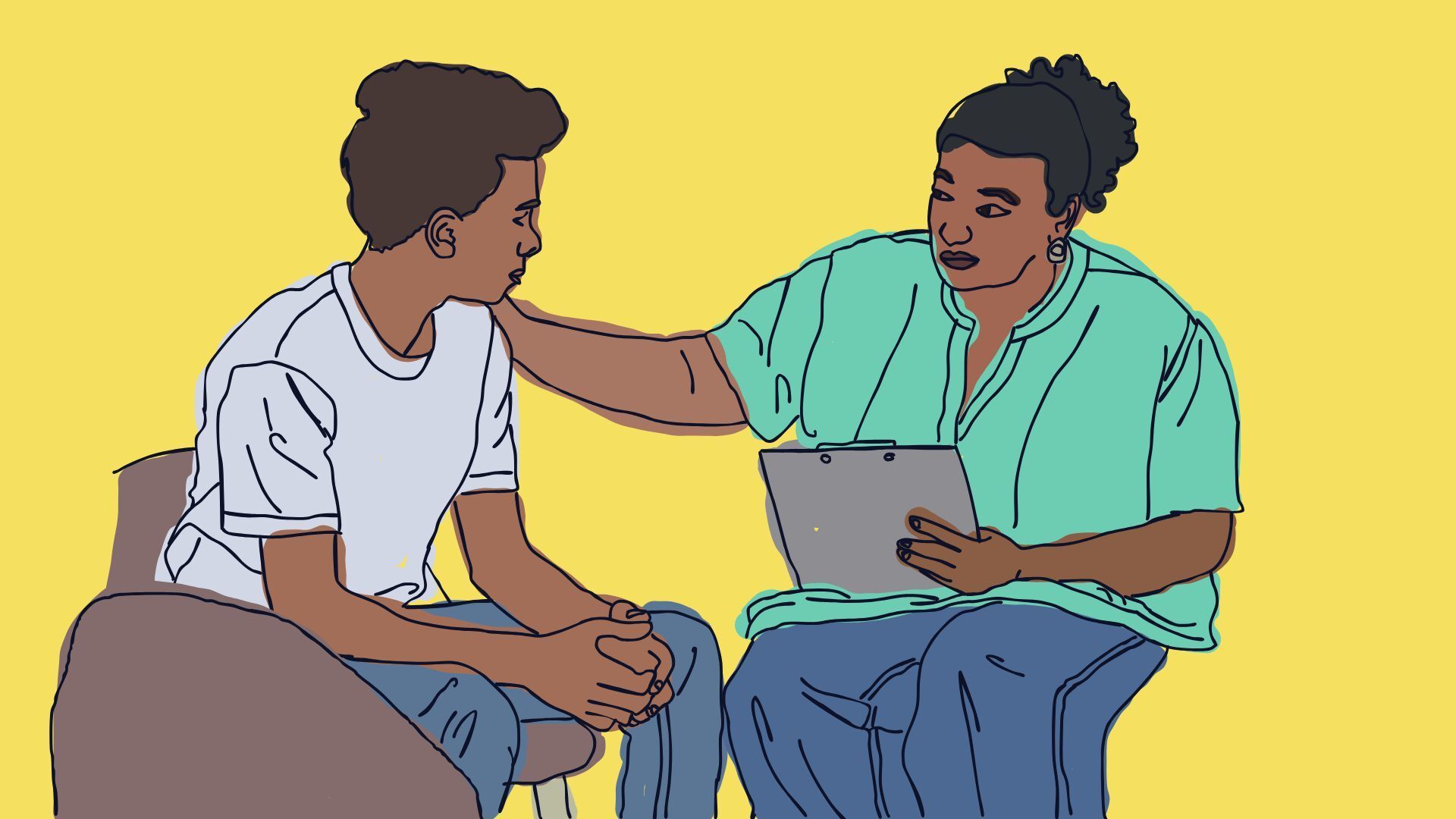
Popular commentators and academics are widely divided on the causes. Social psychology and ethical leadership Professor, Jonathan Haidt, argues that the main causes are the shift to a so-called phone-based childhood and the loss of free-range play during childhood. In her 2025 American Economic Review article, health economist Janet Currie argues that the decline in adolescent mental health observed in the United States (often portrayed as a global phenomenon) reflects long-term structural trends and is largely shaped by physician and patient incentives.
But now on to the data…
Showcase
Today, we share just some quantitative data that illustrate why we should care about this topic, from both an international and local perspective. It demonstrates how it may have shifted over time, as well as the most severe outcomes associated with poor mental health.
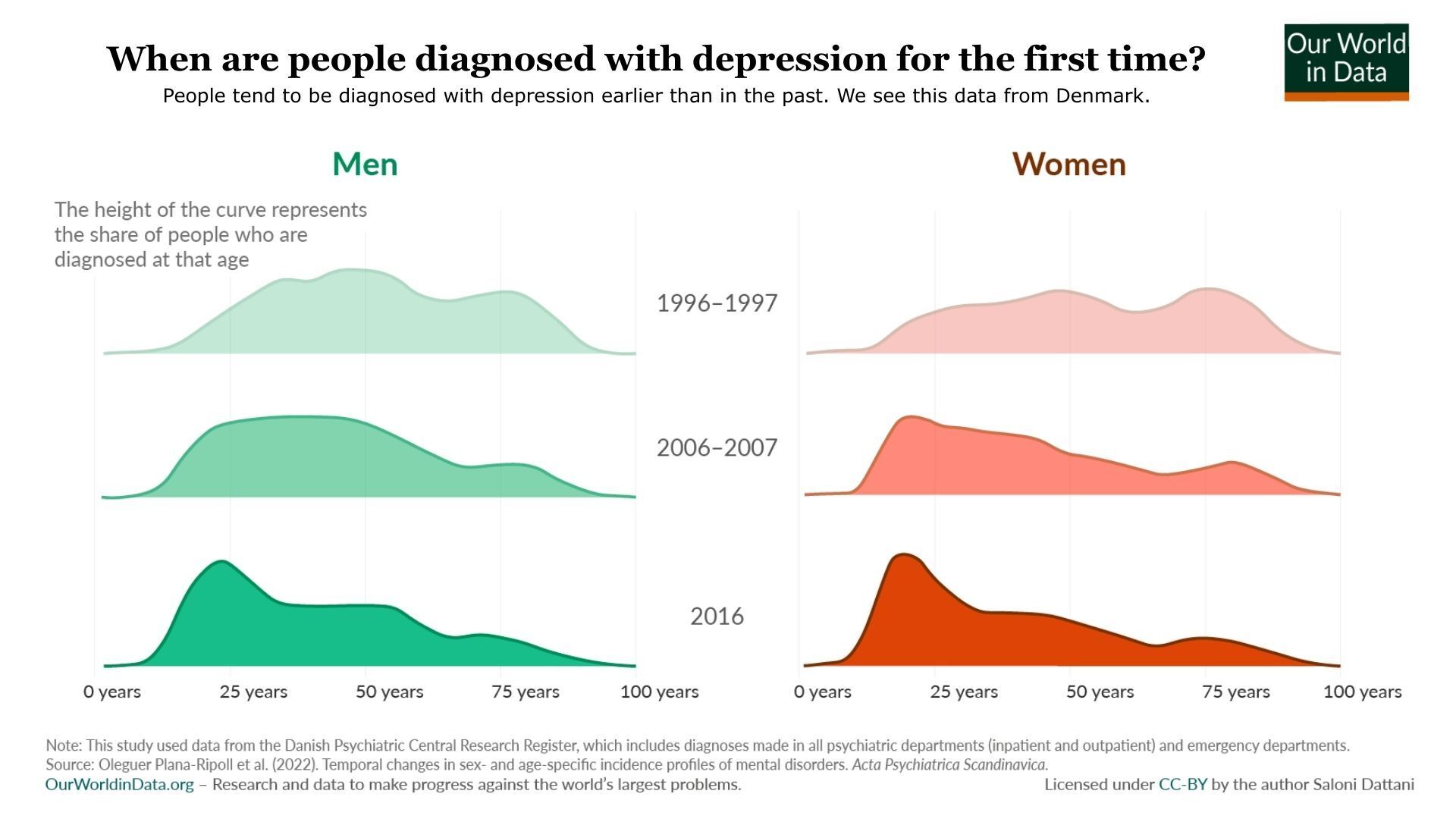
To know whether there is a higher prevalence of poor mental health earlier in the lifecycle compared to decades ago, it is better to consider more objective, clinical data rather than only self-reported symptoms typically associated with poorer mental health states. Data from the Danish Psychiatric Research Central Research Register arguably is some of the most objective longitudinal clinical data available. From these data, we can see that the age of first diagnosis of depression has shifted earlier in the lifecycle, with a clear spike in diagnosis before the age of 25, followed by a gradual decline, by 2016. However, this may reflect better access to psychiatric services, as well as greater awareness of mental health related conditions and not necessarily an increase in population prevalence.
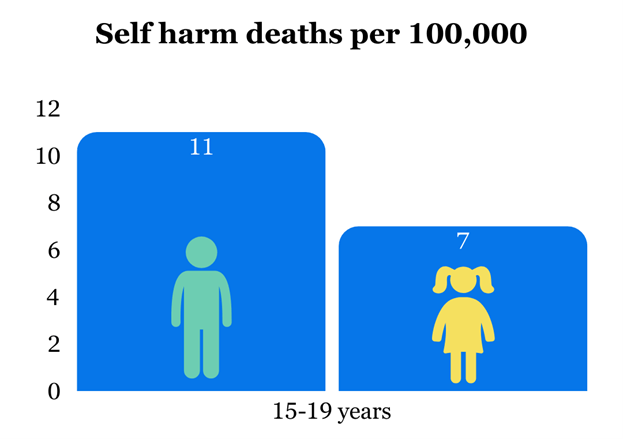
Using UNICEF’s most recently available data as shared in the State of the World’s Children Report 2021, it is clear that there’s a large mental health burden among adolescents. In 2019, using available estimates, one in seven adolescents experienced mental disorders. This burden shows up in cause of death data. Suicide was the fourth biggest cause of death for boys aged 15-19 years in 2019, while it was the third biggest cause of death for girls aged 15-19 years. However, interpersonal violence was the second largest cause of death for boys in this group, also pointing towards the need for mental health support.
We do not have good population-level data on the state of mental health of adolescents in South Africa. But our cause of death data provides some indication of how it shows up in South African society. Compared to global data, suicide features less prominently as a cause of death among all adolescents, overshadowed by other causes of death.
However, interpersonal violence as the top cause of adolescent male deaths, with self-harm1 as the fourth highest cause of death among this group, points towards the potential psychologically destabilising effects of traumatic and tough early-life conditions. Among female adolescents, interpersonal violence is the fifth largest cause of death according to data in the Unicef Adolescent Data Portal. |

Can smart behavioural design help to improve the mental health states of teenagers?
One of the most seminal (causal) studies on the impact of a mental-health targeted behavioural intervention is from a randomised control trial (RCT) conducted by Chris Blattman and colleagues in Liberia. Though the study was conducted on a broader age group than adolescents, it provides insight into the type of factors that can shift deviant behaviour attributable to trauma.
The study, published in 2017, examined the antisocial behaviours of 999 of the highest-risk Liberian men, aged 18 to 35, who exhibited criminal activity like violence, theft and drug-dealing. While the government opted to handle these men through imprisonment or job creation, the study highlighted that rehabilitation programmes addressing mental health concerns can go further, transforming negative habits entirely.
These interventions included:
 | Cash: A non-profit organisation (NPO) ran a lottery where winners received $200 and losers received a $10 consolation prize. |
 | Therapy: Cognitive Behavioural Therapy (CBT) was used to help patients recognise their automatic, usually negative thought patterns. By challenging and reshaping these thoughts, they were able to respond more effectively to everyday situations. Patients also had to practice new behaviours, through repetition and positive reinforcement, to change behaviour and thinking. |
Out of the group of men, a quarter were assigned to receive the cash incentive, 28% were assigned to receive therapy, a quarter were assigned to receive both cash and therapy and 22% received neither. It turned out that the cash and therapy combination had the strongest effect on the group by reducing antisocial behaviours.
“Cash alone and therapy alone initially reduced crime and violence, but effects dissipated over time. When cash followed therapy, crime and violence decreased dramatically for at least a year. We hypothesize that cash reinforced therapy’s impacts by prolonging learning-by-doing, lifestyle changes, and self-investment,” the study stated.
In a South African example, CBT-inspired programme called Shukuma was used to reduce violence between learners in schools. The therapy sessions involved grade eight and nine learners from schools in the Western Cape. They performed group activities where learners had to identify their emotions, learn deep breathing techniques and develop values like empathy, integrity and conflict resolution.
In a future newsletter, we’ll explore the stages in the lifecycle where behavioural interventions can have the greatest impact.
Links we love
Bold Ideas for Brighter Futures (BIBF) is a global conference set to take place in Cape Town next year with an emphasis on child and adolescent mental health. It is the second conference of its kind and the first to take place on the African continent. According to the BIBF website, 300 experts will come together from around the world to share ideas, research and practical innovations aimed at improving the mental health of children and adolescents.
In this TikTok video psychiatrist Dr Willough Jenkins walks viewers through five signs of teenage depression including changes in sleep and appetite and loss of motivation.
An article on the Anxious Generation website details the mental health decline that was recorded among the American youth in the early 2010s. Using data from 2008 to 2022, it visualises big jumps in anxiety levels, major depressive episodes and even emergency room visits for self-harm. However, questions remain about the causal factors driving these changes.
1 Definitionally, there is a thin line between self-harm and suicide as cause of death. Deaths are typically classified as resulting from self-harm when it is not clear that there was a strong intent on the part of the adolescent (person) to die. In contrast, suicide is typically defined as death caused by self-harm with the intent to die. See, for example, this WHO (2019) note.
Our newsletters will feature and rely on many visual elements, if you cannot see the graphics (only text), please select the option from the pop up in this email to change your viewing preferences or manage them under File > Options > Trust Center Settings > Pictures
Reply